
Why Does a Motorcycle Rider Become “Competent” Exactly After 24 Months?
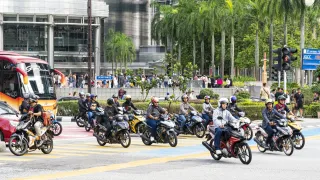
In Malaysia, a new motorcycle rider gets a P-plate. They must ride with it for 24 months. After that? They automatically become a fully licensed rider.

In Malaysia, a new motorcycle rider gets a P-plate (probationary license).
in this article, Dr Rich Hanowski and Datuk Suret Singh present their thoughts on this topic.
They must ride with it for 24 months.
After that?
They automatically become a fully licensed rider.
No additional test.
No new competency assessment.
Just… time.
But here’s the real question:
Does time actually make someone a better rider?
The Reality of the P-Plate System
Two riders can complete the same 24-month probation period.
Yet their real experience may be completely different.
One rider might:
• Ride every day in KL traffic
• Navigate highways, rain, and heavy congestion
• Build thousands of hours of real riding experience
Another rider might:
• Ride occasionally
• Avoid busy roads
• Accumulate very little practical experience
After 24 months, both riders receive the same upgrade.
Time becomes the proxy for competency.
And that’s where the system has a gap.
What If We Measured Skill Instead of Time?
Technology now allows us to measure riding behavior objectively.
Instead of asking:
"Has this rider waited long enough?"
We could ask:
"Has this rider demonstrated real competency on the road?"
This is where platforms like RideHawk™ could support the evolution of motorcycle licensing.
Turning the P-Plate Into a Learning Journey
Imagine if the probation period wasn’t just a waiting period.
Instead, it becomes a structured skill progression.
RideHawk could provide data on:
• braking behavior
• cornering behavior
• acceleration patterns
• hazard response
• riding smoothness
• overall safety score
The Ministry of Transport and Jabatan Pengangkutan Jalan Malaysia ( Road Transport Department Malaysia) have already integrated traffic summons data from Polis Diraja Malaysia, (Royal Malaysia Police) into the Driver Merit & Demerit System Database (Kejara). This is a new, and completely revamped and efficient Kejara system. This valuable database is ideal for surveillance and monitoring the behavior of Probationers License holders as a precondition of upgrading the “P” license to a competent driver’s license (CDL license) after 2 years.
Over time, riders build a real competency profile.
Not just a calendar milestone.
From “Probation Period” to “Competency Pathway”
Instead of a simple 24-month timer, riders could progress through stages:
Stage 1 — Basic Control
Mastering braking, balance, and maneuvering.
Stage 2 — Urban Riding
Handling traffic, intersections, and unpredictable environments.
Stage 3 — Defensive Riding
Hazard awareness and accident avoidance.
Once riders demonstrate consistent competency across these areas, they qualify for a full license.
Not because time passed.
But because skill was proven.
Why This Matters
Motorcycles are one of the most important forms of transportation in Southeast Asia.
But they also account for a large proportion of road injuries and fatalities.
Improving rider competency isn’t just a regulatory improvement.
It’s a public safety opportunity.
The Opportunity for Malaysia
Malaysia already has a structured licensing system.
The next evolution could be simple:
Move from time-based licensing to competency-based licensing.
With modern technology like RideHawk, regulators could gain:
• objective riding data
• measurable skill progression
• better safety insights
• smarter license upgrades
The Big Idea
The P-plate system was designed to encourage safer riding.
But the next step is clear.
Don’t just measure how long someone has been riding.
Measure how well they ride.
Want to discuss further? Let’s talk.
Datuk Suret is a leading road safety champion. He has served as Chairman Miros, Director General of Road Safety & Safety advisor to SPAD. He is co-author of Textbook on Defensive Driving published by JPJ in 1990. He was also the Project lead for the Industrial Code of Safety Practice Guidelines imposed as license condition on Commercial Transport Operators in 2013.He is currently the Advisor to the Malaysian Defensive Driving Riding Centre (MDDRC).
Rich Hanowski is the Co-Founder and Chief Executive Officer of Motorcycle Safety Solutions, Inc. and Motorcycle Safety Solutions Asia (M) Sdn. Bhd. After a 28-year career as a Scientist and Faculty at the Virginia Tech Transportation Institute, Dr. Hanowski is now focused on addressing one of the world’s most challenging road safety issues: Power Two-Wheeler safety.
Contact:
Puvendran A/L Loganathan