Motorcycle Safety Solutions Showcases RideHawk Engineering and Real-World Motorcycle Safety Research at CARS 2026

Kuala Lumpur, Malaysia — Motorcycle Safety Solutions Asia (M) Sdn. Bhd. (MSS) marked its first participation in the Conference on Asia Road Safety (CARS) 2026, held on 19–20 October at the Malaysia International Trade and Exhibition Centre (MITEC), Kuala Lumpur. Organised by the Malaysian Institute of Road Safety Research (MIROS), the conference provided a platform for sharing research and practical approaches to improving road safety. CARS 2026
Across the two-day conference, MSS contributed two complementary presentations examining the engineering evolution of motorcycle collision-warning systems and the deployment of RideHawk™ across different rider populations and operating environments.
Day 1: Engineering the Transition from Legacy FCW to RideHawk ARAS
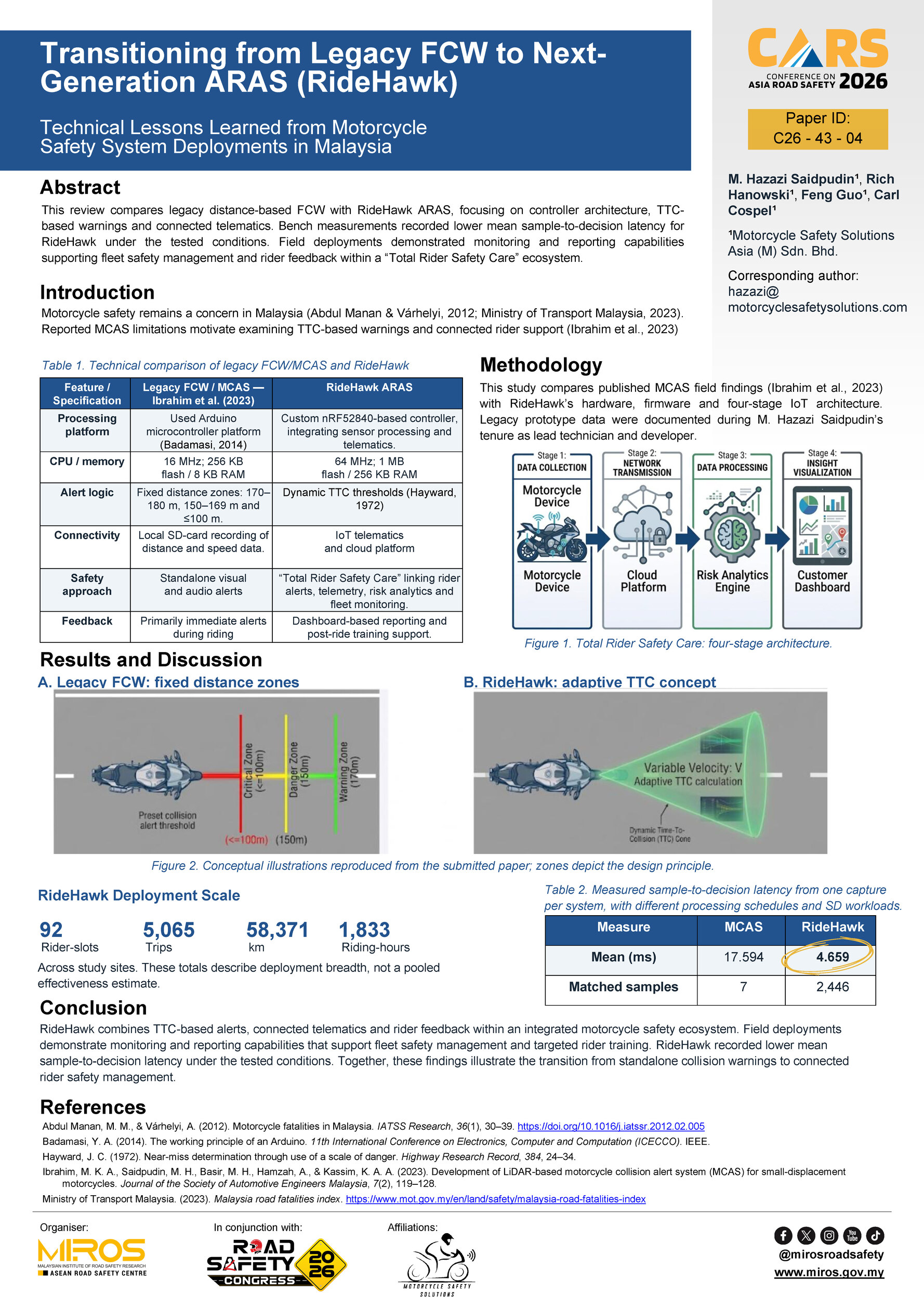
MSS Chief Technician and Lead Developer, Muhammad Hazazi Bin Saidpudin, presented a research poster titled “Transitioning from Legacy FCW to Next-Generation ARAS (RideHawk): Technical Lessons Learned from Motorcycle Safety System Deployments in Malaysia” (Paper ID: C26-43-04).
The poster examined the transition from Arduino-based, fixed-distance warning prototypes to RideHawk’s custom nRF52840-based controller, dynamic Time-to-Collision (TTC) assessment and connected telematics. Its four-stage architecture links the motorcycle device, cloud platform, risk analytics engine and customer dashboard within a “Total Rider Safety Care” ecosystem.
Supporting bench measurements recorded mean sample-to-decision latency of 4.659 ms for RideHawk, compared with 17.594 ms for the legacy MCAS configuration. These results came from one recorded capture per system, with different processing schedules and SD-card workloads, and describe performance under the tested conditions.
The presentation connected hands-on prototype development experience with the engineering requirements of a system that supports rider alerts, remote monitoring and post-ride feedback.
Day 2: Evaluating RideHawk in Real-World Riding Environments
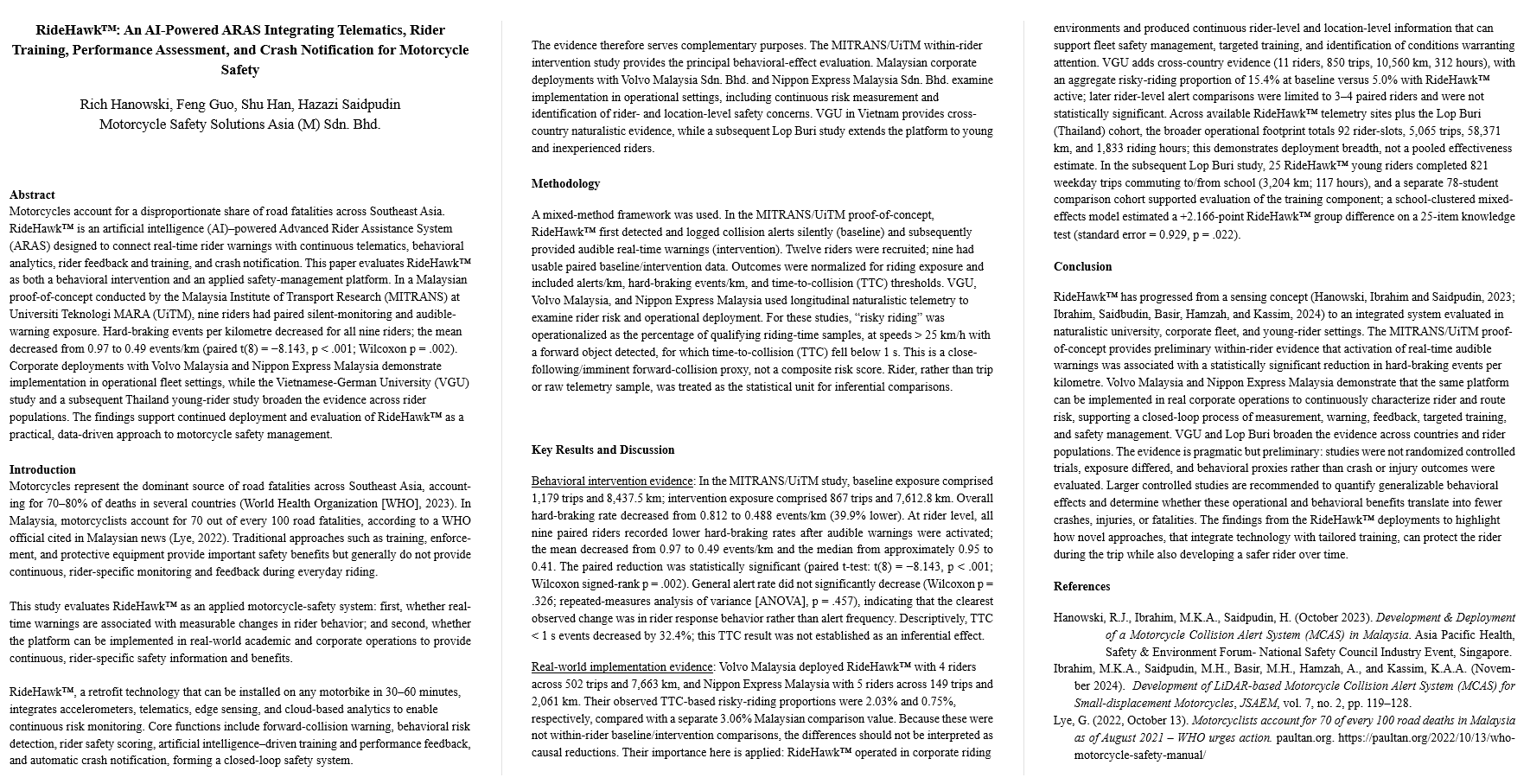
MSS Co-Founder and CEO, Rich Hanowski, PhD, delivered an oral presentation titled “RideHawk™: Real-World Evaluation of an AI-Powered Advanced Rider Assistance System.”
Dr. Hanowski presented RideHawk as a safety-management platform organised around five functions: Sense, Assess, Intervene, Develop and Respond. The presentation described how collision warnings, telematics, rider safety scoring, personalised training feedback and crash notification connect rider protection with ongoing safety management.
The updated presentation reported an operational footprint of 106 riders, 73,291 km and 2,360 riding hours, alongside academic, corporate fleet and young-rider studies in Malaysia, Vietnam and Thailand. These totals demonstrate deployment breadth rather than a pooled measure of effectiveness.
Among the findings, the MITRANS/UiTM study reported that all nine riders with paired baseline and intervention data recorded lower hard-braking rates after audible warnings were activated. The rider-level mean decreased from 0.97 to 0.49 events per kilometre. This preliminary observational evidence concerns riding behaviour rather than measured reductions in crashes or injuries.
Connecting Engineering, Data and Rider Development
The conference also highlighted three collective-action priorities: protecting motorcyclists, integrating data and building a culture of safety. These priorities featured in the opening presentation by Malaysia’s Deputy Prime Minister, Datuk Seri Dr. Ahmad Zahid Hamidi.
MSS’s presentations explored how connected motorcycle technology can contribute to those priorities: providing warnings during a journey, turning riding data into information for safety decisions, and supporting continuous rider feedback and training.
Together, the two presentations demonstrated MSS’s approach to linking engineering development with field evaluation—advancing RideHawk from a standalone warning concept toward connected motorcycle safety management.
Missed our presentations at CARS 2026? Download the poster and presentation slides below to explore our research and findings.