Independent Malaysian Pilot Study of RideHawk™

Motorcycle Safety Technology for Riders Carrying Pillion Passengers
The Malaysia Institute of Transport (MiTRANS) at Universiti Teknologi MARA (UiTM) conducted a proof-of-concept pilot study evaluating Motorcycle Safety Solutions’ motorcycle collision-alert technology in real-world riding conditions involving pillion passengers.
The study examined whether providing riders with real-time audible collision warnings could influence riding behaviour, while also assessing rider and pillion-passenger perceptions of safety, confidence and comfort.
The Study
Twelve UiTM motorcycle riders who regularly travelled with pillion passengers were initially recruited. Nine riders were included in the final comparison between the baseline and intervention phases.
During the baseline phase, the system detected and recorded potential collision alerts but did not warn the rider. During the intervention phase, audible warnings were activated, providing riders with real-time notification of detected collision risks.
This allowed MiTRANS researchers to compare riding behaviour before and after riders began receiving the warnings.
Key Findings
The most notable result involved hard braking, an important indicator of abrupt rider response.
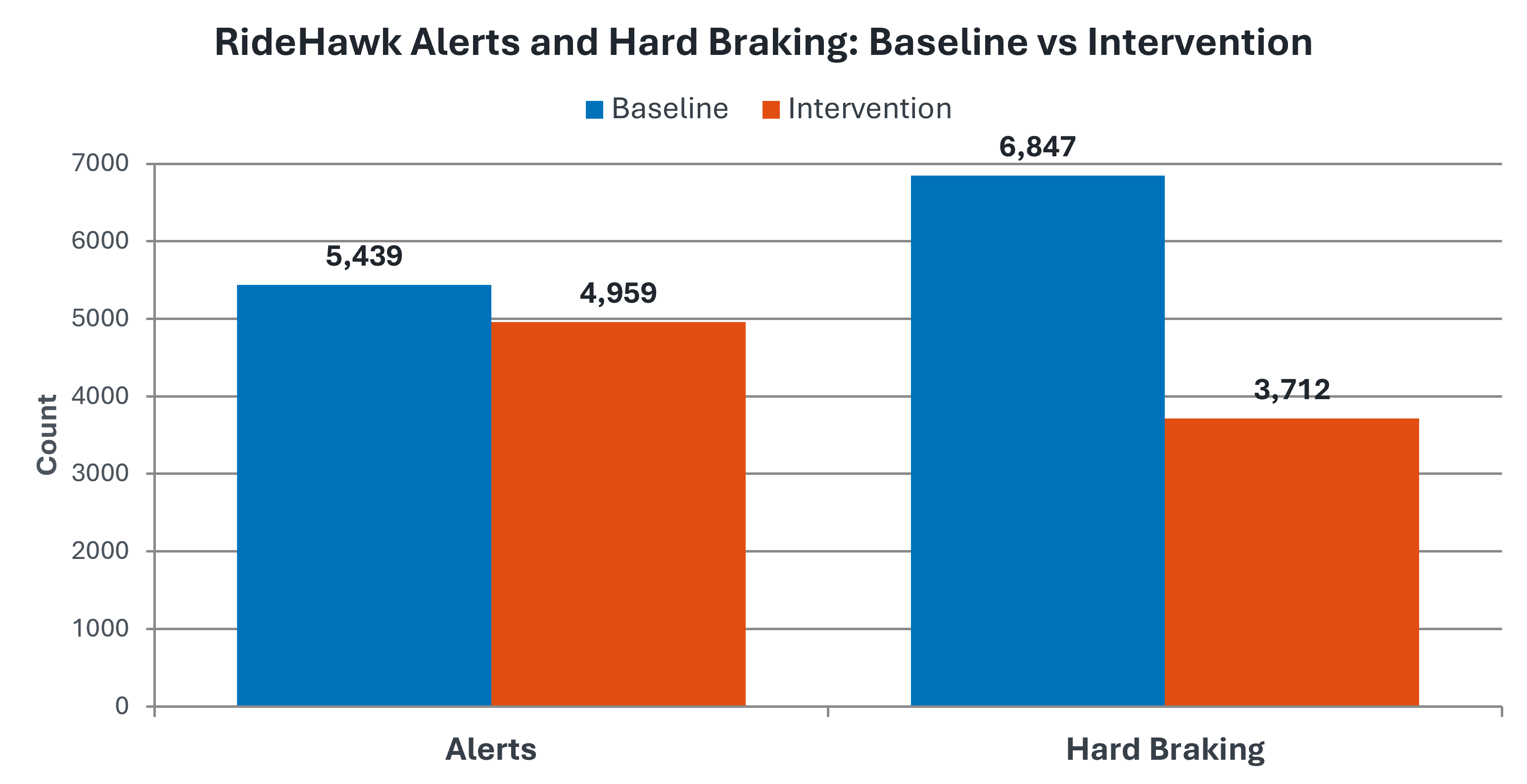
Across all nine riders included in the comparison, hard-braking rates were lower during the intervention phase. The average rate declined from 0.97 hard-braking events per kilometre to 0.49 events per kilometre — a reduction of approximately 49.5%.
Statistical analysis found the reduction to be significant:
· Paired t-test: p < 0.001
· Wilcoxon signed-rank test: p = 0.002
MiTRANS concluded that the hard-braking results provided stronger evidence of system effectiveness than the alert-rate results and that the audible warning may have helped riders react earlier and avoid abrupt braking actions.
Most riders also experienced lower collision-alert rates per kilometre during the intervention phase. However, unlike the hard-braking result, the reduction in alerts per kilometre was not statistically significant in the MiTRANS phase-based analysis.
Importantly, this finding should be considered alongside the significant reduction in hard braking. Collision alerts reflect the situations riders encounter as well as their riding behaviour, whereas hard braking reflects how riders respond to those situations. The finding that every rider reduced hard braking, with the overall reduction reaching statistical significance, suggests that the clearest effect of the warning system in this pilot was improved rider response — earlier, smoother braking — rather than eliminating the circumstances that trigger collision alerts.
This interpretation is consistent with MiTRANS's overall conclusion that the system appeared to be more effective in improving rider response behaviour than in reducing overall exposure to alert-triggering situations.
Rider and Pillion-Passenger Response
The study also examined how riders and their passengers perceived the technology. MiTRANS reported that both riders and pillion passengers responded positively to the system, including reported improvements in confidence, situational awareness and perceived safety while riding.
What MiTRANS Concluded
MiTRANS concluded that the system could be implemented in real-world motorcycle riding conditions involving pillion passengers and that the findings showed promising potential to improve motorcycle safety.
The researchers identified the reduction in hard braking as the clearest behavioural finding, while also noting the limitations of a proof-of-concept study, including the small sample size, differing intervention periods and data-availability constraints. They recommended larger and longer-term studies.
Full MiTRANS Report
The complete 72-page MiTRANS/UiTM research report contains the study methodology, rider and pillion-passenger survey results, individual rider analyses, statistical testing, figures, tables and references.
To request a copy of the full report, contact: